Can’t play the video? Watch here.
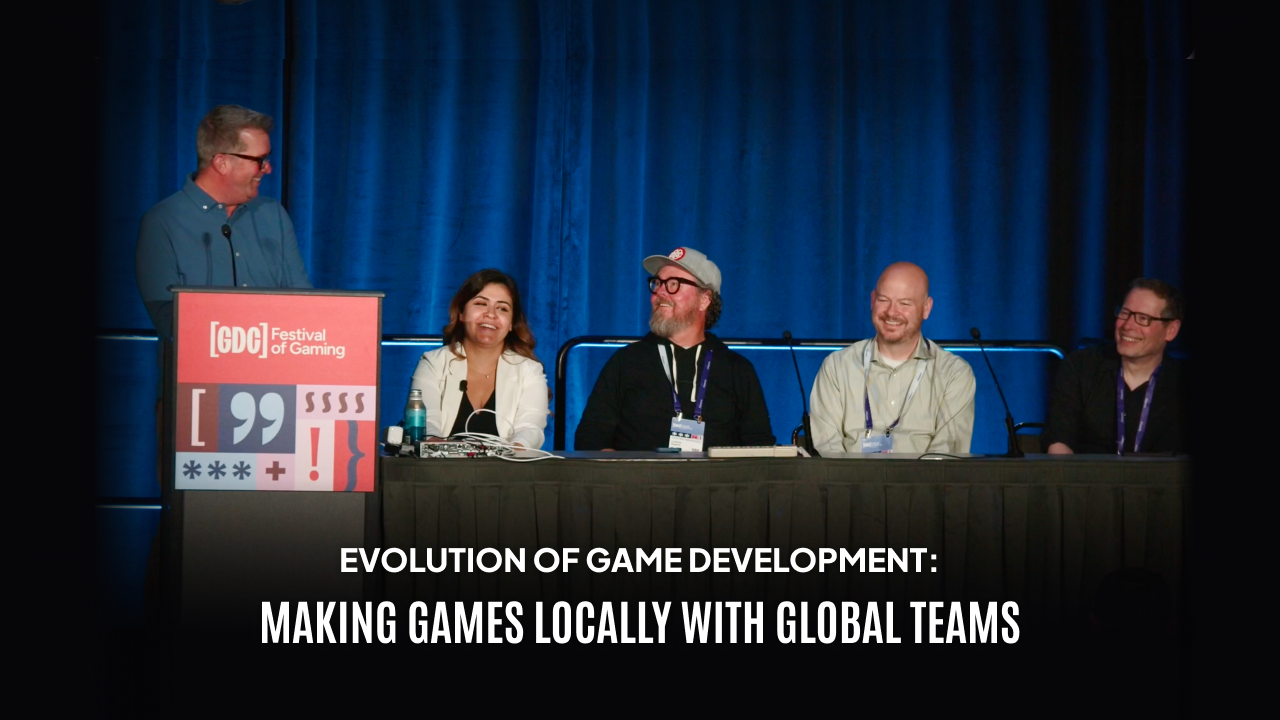
At GDC 2026, Dennis Cooper, Regional Director for North America at Virtuos, moderated a panel exploring how studios make games locally while drawing on global talent. Joining him were Jason Smith (Founder, GameCaviar), John Doyle (Head of Internal Production, PlayStation), Kay Arutyunyan (General Manager, CounterPunch Studios), and Lindsay Gupton (CEO, Pipeworks – A Virtuos Studio),
Together they traced co-development’s shift from linear outsourcing to integrated creative partnership – and what it actually takes to make distributed development genuinely collaborative.
Key Takeaways:
Co-development has moved well beyond outsourcing – and it’s not going back
External partnerships now represent 40–50% of production spend on major titles. The pandemic normalized distributed work and built the habits for it. As Jason Smith put it: right now it’s co-development, but at some point it will just be called development.
The best partnerships treat everyone as one team, not two companies
When one side holds all the ideas and the other just executes, that’s vendor work. The studios getting the most from global partners give them genuine ownership, welcome their input, and let expertise – not company affiliation – determine who leads.
Global reach plus local presence is the winning formula
Global teams unlock talent no single region can match. Local presence removes time zone friction and builds rapport quickly. The model that works is trusted people embedded in the client’s region, working back to a global team.
Alignment before execution, every time
Almost every co-development failure traces back to insufficient alignment upfront. A brief and a few Zoom calls are not enough. Getting people into the same room is what actually establishes shared understanding.
Trust is the most important word in co-development
Start small, demonstrate capability, scale responsibility over time. Studios that invest in trust carry it into the next project – avoiding the cost of starting from scratch every time.
Pre-planning, transparency, and honest communication are non-negotiable
Foresight beats firefighting. Both sides need full visibility on what’s working and what isn’t — withholding information on either side sets the whole engagement up to fail.
People make games – treat them like humans
The panel pushed back on “resources”, “staff days”, and “man days”. Dehumanizing the process creates a ceiling on what co-development can achieve. Face-to-face time and personal connection is what unlocks the best of a partnership.
Talk Chapters:
Intro (00:00 – 00:28)
Dennis Cooper introduces the session and panel: John Doyle (PlayStation), Lindsay Gupton (Pipeworks), Kay Arutyunyan (CounterPunch Studios), and Jason Smith (GameCaviar).
“Co-development isn’t new. What are some ways you have seen it change in the last three to four years?” (00:28 – 06:04)
The panel charts co-development’s evolution from outsourcing to creative partnership. The pandemic was the forcing function – it normalized remote work and built comfort with distributed collaboration. Post-pandemic, the driver shifted to cost efficiency and flexible capacity. With external spend reaching 40–50% of project budgets, co-development has become a CFO-level conversation, not just a production one.
“What makes working with global teams challenging, and what makes local teams great?” (06:04 – 10:03)
Global teams offer talent and creative diversity that no single region can provide. The challenge is alignment overhead – studios consistently underestimate how much senior involvement is needed upfront. Local presence solves much of that friction: people in your time zone who can bridge the gap to the wider team and build rapport fast.
“If we could create the ideal co-dev scenario, what would it look like?” (10:03 – 25:14)
The panel’s centerpiece. One-team thinking is the foundation, with trust built incrementally from small beginnings. John Doyle shares examples of partner teams growing into pod leads on first-party PlayStation titles, with expertise – not company – determining who led. Kay Arutyunyan names three pillars: pre-planning, transparency, and honest communication. The discussion closes on the human side: the value of face-to-face time, and a call for a shared industry security standard to reduce duplicated friction across publisher audits.
Q&A Session (25:14)
How do you assess partner fit before a high-stakes production? Start small. Pick low-risk work, build it together, and see how teams interact before scaling. Going all-in too early carries a very high price of failure.
Frequently Asked Questions (FAQs):
Outsourcing is transactional: brief in, deliverable out. Co-development is collaborative: partners are aligned to the creative vision early, empowered to problem-solve, and collaborate closely as an extension of the internal team. Instead of a fragmented multi-vendor project with many complex dependencies, a co-development partnership offers a unified, streamlined, and simple way for developers to access expertise across the entire production pipeline.
Communication gaps and insufficient upfront alignment. Studios that invest in face-to-face visits, clear communication norms, and local contacts in the client’s time zone consistently get better results than those that rely on briefs and Zoom calls alone.
It starts small, builds trust incrementally, and scales responsibility as the relationship matures. The best partnerships evolve — often ending up doing entirely different things than originally scoped — because both teams have learned what each other is truly capable of.
Start small. Pick a low-risk piece of work, build it together, and see how the teams communicate and handle creative feedback before committing to a larger engagement.
More important than most studios expect. Almost every struggling engagement improves after in-person visits. Building personal relationships between leads consistently produces better outcomes than purely remote collaboration.
By making it clear from the start that good ideas can come from anyone, regardless of company. When both sides feel safe to push back and debate, creative friction tends to produce better decisions than either team would have reached alone.
Ready to build a co-development partnership that performs like one seamless and successful team? Reach out to our team to find out how we can help today.