Can’t play the video? Watch here.
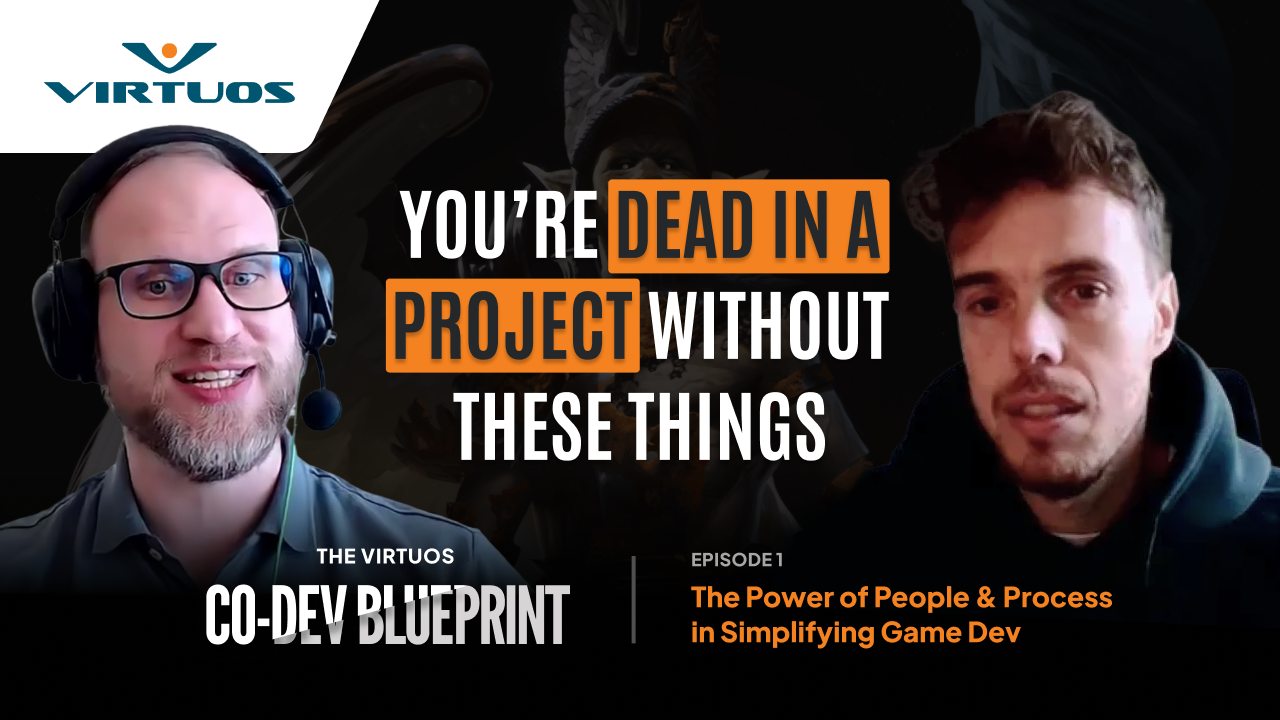
In the first episode of the Co-dev Blueprint, we discuss one of the industry’s toughest challenges: simplifying complexity in large-scale game projects. Hear from experts at Virtuos’ studios: Alex Murphy (Executive Producer, Virtuos Paris), Yago Perez (Art Director, Black Shamrock), Kirsty Fraser (Lead Programmer, Third Kind Games), and Joseph Cabanis (Software Engineer, Virtuos Labs – Montpellier), as they share insights on best practices for efficient co-development and achieving quality results that drive success for game developers worldwide.
Key Takeaways:
Understand the full scope
Grasp the entire project’s scale, deadlines, and budget to make informed decisions that ensure consistent quality across all assets rather than perfecting isolated elements.
Centralize communication and build trust
Streamlined client relationships managed by a small number of trusted production leads simplify complex collaborations across studios worldwide.
Automate where possible, handcraft where it matters
Use procedural generation for repetitive, generic assets. Reserve manual effort for key narrative or player-interactive elements.
Prototype early and iterate frequently
Small, early prototypes allow rapid validation, adaptation, and prevent costly rework downstream.
Leverage a global network of experts
Access to specialists across studios and decades of shared knowledge accelerates problem-solving and technical innovation.
Balance risk and reward in performance fixes
Implement “safe” fixes to meet deadlines while planning for longer-term optimizations when feasible.
Keep open communication across disciplines
Defining and agreeing on the value and priorities of tasks among Engineering, Art, and Production is crucial for efficient iteration and delivery.
Plan with margin and embrace flexibility
Expect the unexpected with delivery buffers and remain adaptable as project needs evolve.
Remember to have fun!
Sustaining team enjoyment and passion is vital during intense development cycles.
Episode Chapters:
Setting up efficient global organizations (03:41 – 12:15)
Alex discusses structuring a large co-development network, acting as a “one-stop shop” for the client, and the necessity of trusting your team to manage priorities and deadlines across different studios.
Balancing automation, handcrafting, and quality (12:15 – 20:03)
Yago explains how to manage a large volume of assets by deciding when to use procedural tools and automation versus investing manual effort on “hero assets” to ensure quality and consistency across the world.
Custom tool development and prototyping (20:03 – 27:12)
Joseph details the process of custom tool development, emphasizing the need to create a prototype first, validate the technology, and be willing to refactor or change direction for an optimal, long-term solution.
Anticipating and optimizing performance issues (27:12 – 35:00)
Kirsty shares how expertise in live operations helps teams anticipate and fix performance and optimization issues earlier in the development cycle by approaching a client’s code base with a fresh perspective and considering long-term practice.
The core role of people and communication (35:00 – 43:41)
The discussion returns to the fundamental role of people and trust in the industry. The panel emphasizes the need to define the “value-add” of tasks and maintain open communication between all disciplines to balance iteration and deadlines
Learn more about simplifying development for your game by reaching out to the team today.