Can’t play the video? Watch here.
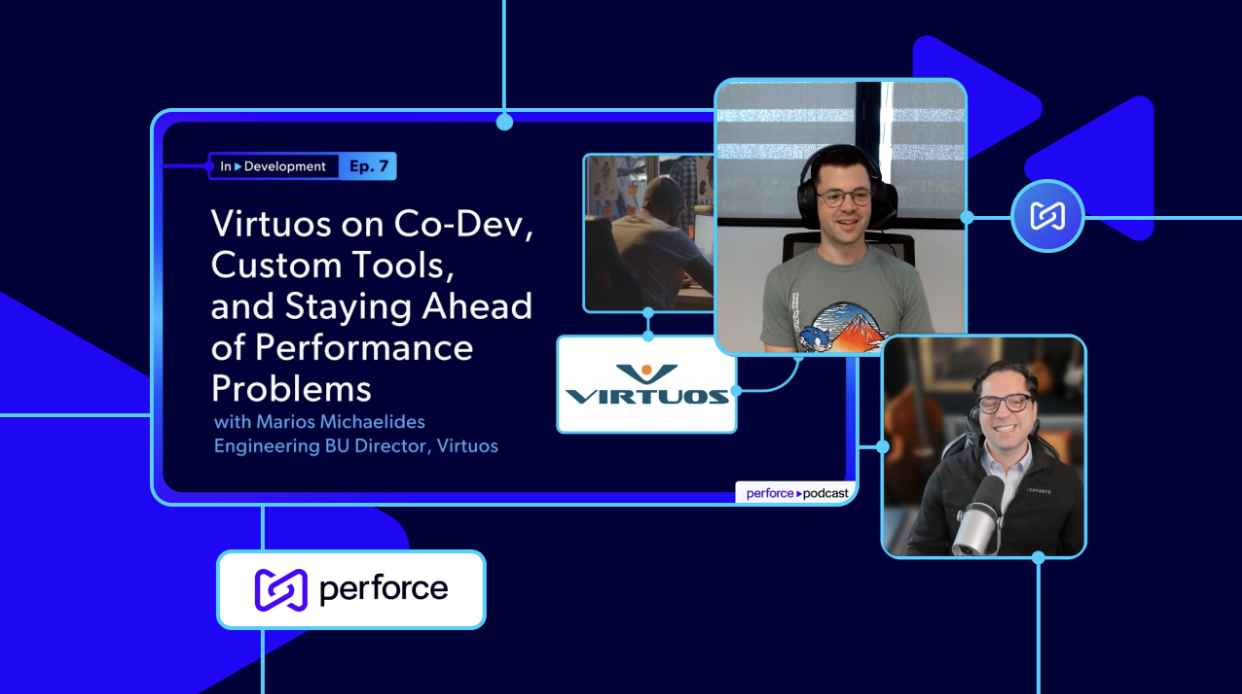
In a recent episode of Perforce’s In Development podcast, host Jase Lindgren sat down with Marios Michaelides, Engineering Director at Virtuos, to dig into the real technical work behind co-development at scale. Marios shares hard-won lessons from working across multiple AAA projects — from the painful performance cycles that derail schedules and burn out developers, to how his team built a platform to catch problems before they become crises.
The conversation covers Virtuos’ engineering philosophy, Virtuos’ proprietary “Goliath Game Optimization Platform” which includes performance dashboards and asset health pipelines, and why being proactive about optimization — regardless of studio size — is one of the most valuable habits a development team can build.
Key Takeaways:
Co-developers are responsible for building tools now more than ever
As studios move from proprietary engines to Unreal and Unity, they lose the custom tooling they relied on and need to rebuild it. Co-developers like Virtuos are increasingly involved from pre-production onwards, helping partners identify what’s missing and build the infrastructure their pipelines depend on.
Performance problems left unchecked become schedule emergencies
Marios describes a project where optimization work restarted repeatedly as new content came in, eventually requiring a massive late-stage team scale-up to hit targets — with significant overtime across the board. The lesson: the cost of fixing performance problems at the end of a project is far higher than catching them early.
The Goliath Game Optimization Platform gives teams visibility across every build
As part of the Goliath Game Optimization Platform, Goliath Performance is made up of an easy-to-read dashboard that provides transparency on the performance of a game at any point in time. The platform is integrated with Unreal Insights and developers’ own CI/CD systems, so it can capture all performance data automatically. Rather than surfacing specific bugs, it shows how performance evolves over time — so when a new feature causes a regression, teams see it immediately and can decide how to respond before it compounds.
Asset validation closes the gap between content creation and performance budgets
Goliath Asset Health is another in-house tool that Virtuos has developed as part of the Goliath Game Optimization Platform. Goliath Asset Health is used for performance tracking, mainly focused on asset validation. It runs rules against assets at submission time and as part of nightly builds, flagging anything that falls outside project budgets. The million-triangle elevator button is a real example: without automated validation, no one is manually checking every asset in a complex open world.
Don’t optimize too early, but have infrastructure in place before you scale
Finding the fun comes first. But by the time a team enters full production and starts scaling content, performance guardrails need to already be in place. Waiting until after scale-up to introduce these tools means catching up against a much larger problem.
Be proactive regardless of studio size
Marios’ core message is not about Virtuos tooling specifically — it’s about mindset. Even a two-person team building something small to track performance is already ahead of studios that wait until a crisis forces the issue.
Players notice performance more than ever
Audiences are increasingly aware of frame rates, hitches, and technical quality — and are vocal about it. Studios that treat performance as an ongoing development concern rather than a final-stage checkbox are better positioned to meet those expectations at launch.
Episode Chapters:
Meet Marios from Virtuos’ Engineering Division (01:42 – 04:41)
Marios introduces his role leading the engineering services unit at Virtuos, where teams develop technology, tools, rendering solutions, and gameplay features for co-development partners worldwide.
Tool Stack, Frameworks, and Task Management (04:41 – 07:46)
An overview of Virtuos’ internal tech stack — Blazor for web components, MongoDB for backends, Rider and Visual Studio for engine work — and how the team adapts to whatever tools and pipelines each partner requires, with Jira as an internal preference for task management.
Generalists vs Specialists (07:46 – 08:59)
Co-development breeds both: developers who build broad generalist skills across many tools, and those who go deep on one — Houdini being a prime example as procedural content generation grows in importance.
Performance Pain Cycles and Asset Validation Horror Stories (08:59 – 14:20)
Marios recounts the project that shaped his thinking: repeated optimization restarts, a brutal end-of-project crunch, and the realization that without proactive systems, the same pattern repeats. Includes the now-famous million-triangle elevator button — an asset that made it through multiple years of development undetected.
The Goliath Performance Dashboard (14:20 – 25:18)
A detailed look at how Goliath Performance works: cameras placed in game levels, automated CI/CD runs capturing Unreal Insights data, a backend storing results persistently, and a web dashboard with programmer and artist modes giving different stakeholders the visibility they need. The tool doesn’t just flag problems — it shows how performance trends over time so teams can respond to regressions as they happen.
When to Optimize — and How to Scale with Guardrails (25:18 – 31:53)
The balance between finding fun and maintaining performance. Marios argues for having infrastructure in place before scale-up begins — not optimizing from day one but not waiting until the project is in crisis either. Asset validation pipelines need to be active before the content volume makes manual checking impossible.
Budget Reality of Tools and Players Noticing Performance (33:38 – 36:42)
Most studios understand the value of tooling but struggle to justify the internal spending. Marios acknowledges the difficulty of proving ROI when you can never run the same project twice — with and without the tool. Meanwhile, players have become genuinely performance-literate, raising the stakes for studios that deprioritize it.
Advice, Uncertainty, and Experimenting With New Tech (36:42 – 45:29)
Closing advice for developers entering the industry or moving into co-dev and tools roles: plan for uncertainty rather than hoping things go smoothly and stay curious about new technology. Marios shares a standout example from ChinaJoy — an AI-driven NPC that responds to spoken player requests in real time, navigating the complexity of regional dialects — as an example of what happens when teams experiment boldly and solve the hard problems that follow.
Frequently Asked Questions (FAQs):
Before full production scale-up. Development teams should focus on finding the fun first, but by the time content creation ramps up significantly, both a performance tracking system and an asset validation pipeline should already be active. Introducing them after scale-up means dealing with a much larger backlog of issues.
No. Marios is explicit on this point: even a two-person team building something basic to track performance is ahead of the curve. The tools don’t have to be sophisticated — the habit of monitoring project health continuously is what matters, at any scale.
Are you having issues with performance and optimization for your game? Reach out to our team to find out how we can help today.