Can’t play the video? Watch here.
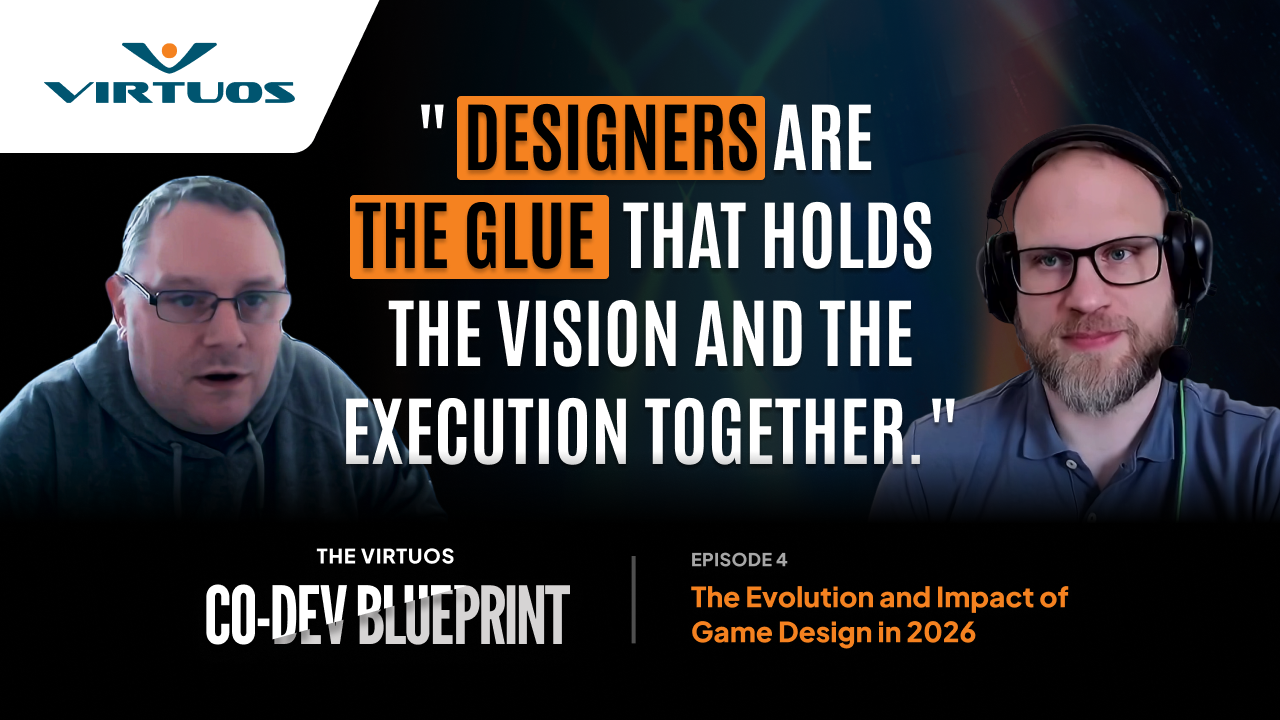
In the fourth episode of the Co-Dev Blueprint, we explore one of the most discussed — and least clearly defined — disciplines in game development: game design. As games grow more complex, studios increasingly rely on co-development partners not only for execution, but for specialized design expertise. Collaborative game design has become not just viable, but essential.
Join senior design leaders from across Virtuos’ global studios: Cheong Jaeho (Game Design Director, Virtuos Seoul), Nicolas Roginski (Design Director, Virtuos Paris), Sean Fitzpatrick (Creative Director (Design), Black Shamrock – A Virtuos Studio), Randy Vazquez (Lead Game Designer, Virtuos Kuala Lumpur), and Harold “Hal” Milton (Studio Design & Creative Director, Pipeworks – A Virtuos Studio), as they share candid insights on what game design really means in 2026, the friction points that arise in collaborative development, and how the best teams navigate them.
Key Takeaways:
Game design is the connective tissue between disciplines
Design has evolved beyond a single role or department. It is the set of decisions that shape the player experience, binding art, engineering, production, and narrative together. Designers are the “glue” that holds a project together — making ideas tangible and delivering on a shared vision.
Act as a compass on a rocking ship
In an era of live service games and continuously evolving IPs, designers must balance two critical missions simultaneously: maintaining a clear creative direction while staying flexible enough to adapt to change. The rising failure rate among recent AAA titles is evidence of what happens when this balance breaks down.
Design has shifted from paper to engine
As production tools and scripting systems grow more powerful, game design has moved away from documentation-driven workflows toward direct in-engine implementation, tuning, and iteration. Individual designer impact is greater than ever — but so is the demand for speed and clarity.
Checklist-driven design is failing players
When games are shaped primarily by trend-chasing, marketing data, and top-down decisions disconnected from development, players — who are smarter and more discerning than ever — will notice. Success in 2026 comes from focus, strong execution, and intentional design, not from feature checklists.
Start early, scale trust over time
Design adds the most value when embedded from day one — during vision-setting, not as a reactive fix later in production. A pod-based co-development model, where designers work as true extensions of the client team, enables faster iteration and stronger outcomes. Starting small and scaling responsibility over time is the most effective path.
The player is always the final client
Every design decision should ultimately serve the player experience. Audiences today have high expectations around quality, fairness, and respect for their time. When features genuinely improve the experience, players respond clearly and positively — as seen on The Elder Scrolls IV: Oblivion Remastered, Cyberpunk 2077, and New World.
Communication and trust are everything
Whether managing internal stakeholders, business and publishing partners, or external co-development teams, the quality of communication determines the quality of the collaboration. Shared vision sessions, regular one-on-ones with client counterparts, and live cross-discipline play sessions all help keep teams aligned and reduce costly misalignment.
Assume competence; remove ego
Great collaboration starts with respect. Assume everyone in the room has a reason to be there. Be willing to be wrong. When designers focus on what the game needs — rather than defending their own ideas — better decisions follow.
Episode Chapters:
Introductions (00:00 – 05:24)
This segment introduces our panel of experts from Virtuos studios in Seoul, Paris, Dublin, Kuala Lumpur, and Eugene (Oregon). Each guest shares their extensive industry background, ranging from 20 to 30 years of experience on major AAA titles. Together, they establish their roles and the global perspective they bring to the discussion on modern game design.
What does game design actually mean? (05:24 – 14:31)
The panel unpacks their personal definitions of game design — from “acting as a compass on a rocking ship” to “design as alignment over authorship” to “making ideas tangible.” A lively discussion on how the discipline has evolved from documentation-heavy workflows to engine-driven, cross-functional collaboration.
What’s shaping game design in 2026? (14:31 – 24:41)
From the rise of console and PC gaming across Asia to the push-and-pull between AAA scale and indie creativity, the panel shares their perspectives on the forces reshaping the industry — including the growing consequences of checklist-driven design and the increasing influence of AI on development pipelines.
Common friction points in co-development design (24:41 – 34:13)
The panel gets candid about the real challenges that arise in game design collaborations: internal disagreements between disciplines, the tension between development teams and business and publishing stakeholders, the high cost of joining a project too late, and the difficulty of building trust when design is inherently subjective.
What makes collaborative design work — and stories from the field (34:13 – 49:26)
Drawing on real production experience across titles including The Elder Scrolls IV: Oblivion Remastered, Cyberpunk 2077, New World, Skull and Bones, Kingdoms of Amalur, Grounded, and Marathon, the panel shares the principles and practices that make design collaboration succeed — from clarity of vision and cross-discipline empathy to live play sessions and ego-free decision making.
Bonus: One game that got design right (49:26 – 56:47)
The panel picks the games outside of Virtuos’ projects that they consider standout examples of great design — and shares a few thoughts on where the industry is headed next.
Want to learn more about how collaborative game design can sharpen your gameplay and reduce creative risk? Reach out to our team today.